Airdrie Burgh Police – Outstanding Service
CONSTABLE ALEXANDER (SANNY) LUMSDEN
AIRDRIE BURGH POLICE – 1903 TO 1946
Alexander Lumsden was born on the 9th of April 1883 at Lintrathen, Forfarshire. His father was a farm worker. He was educated in the area and on leaving school he worked as a farm labourer.
On the 13th of October 1903 he changed his career, travelling to Airdrie to join the Airdrie Burgh Police as Police Constable No 11. He was also given the nickname ‘Sanny’.
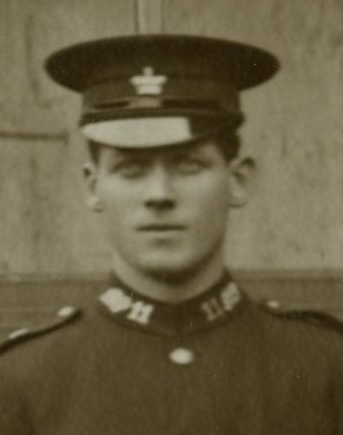
Constable Alexander ‘Sanny’ Lumsden – 1912
On the 10th of January 1908, Alexander married Sarah Raeside, a 24-year-old machinist from Airdrie. They went on to have six children.
Sanny worked in various areas of the town including the town centre, Rawyards and Clarkston. The following relates to one of the incidents he dealt with in the Airdrie Town Centre area.
On Friday the 19th of June 1908, Before Sheriff Glegg at Airdrie Sheriff Court, William Myles, miner, residing in Bell Street, Airdrie, appeared on remittal from the Tuesday’s Burgh Court. He had been released on bail on charges arising from incidents which occurred on Monday the 15th of June 1908, in High Street, Airdrie.
The charges were as follows:
Having on Monday the15th of June 1908, in High Street, Airdrie,
- assaulted Robert Fraser, carter, of Chapel Street, and James M‘Intyre, engine driver, of Gardensquare, striking them several severe blows on their mouths and faces with his clenched fists to the effusion of blood and the hurt and injury of their persons.
- having, while being conveyed to the Police Office on the above charge, assaulted Constable George Ross and Alexander Lumsden, while in uniform and in the execution of their duty as constables, butting them on their faces with his head, kicking them on the legs with his booted feet, and biting Constable Lumsden on the right leg.
The prosecution was conducted by Mr A. D. Lindsay, Procurator Fiscal, and the accused was defended by Mr James Bell. William Myles pleaded not guilty. He appeared in the dock with his head swathed in bandages.
Evidence for the Prosecution
The first complainers, Fraser and McIntyre, testified that they had been assaulted at the top of Bell Street while returning home from a Sons of Temperance meeting.
At about 10.10 p.m. on Monday evening, they had stopped at the top of Bell Street and were conversing. Fraser called across the street to a man he knew, James Paterson, whereupon the accused, who was standing at the door of his house, crossed the street and challenged both men to fight, using obscene language.
The complainers told him to go away, stating they wanted nothing to do with him. Without provocation, however, the accused struck first one and then the other on the mouth. McIntyre was knocked unconscious and fell onto the roadway.
James Paterson and William Tanish gave corroborative evidence in support of this account.
Police Evidence
Constable Alexander Lumsden stated that at about 10.20 p.m. he received information regarding the assault on Fraser and McIntyre. Along with Constable George Ross, he went in search of the accused, whom they knew. Sergeant Whyte also attended and searched nearby back courts.
The officers observed the accused standing on Bell Street and walked towards him. As they approached, they heard him remark, “There’s only two of them.” Constables Ross and Lumsden each secured one of his arms. The accused immediately struck out violently, kicking both officers on the legs. During the struggle, all three fell to the pavement.
As Constable Lumsden’s trouser leg was pulled up, exposing his calf, the accused seized the opportunity, opened his mouth, and bit deeply into the officer’s leg, causing severe pain and profuse bleeding. The accused also headbutted both officers during the struggle.
Eventually the constables gained control and pulled the accused to his feet, attempting to escort him to the Police Office. He continued to resist violently, struggling and shouting to onlookers to come to his assistance. When given another chance to walk, he again kicked Constable Lumsden, an act witnessed by Sergeant Whyte, who had by then arrived.
The accused was carried some distance before calming down and walking the remainder of the way to the Police Office.
Constable Ross and Sergeant Whyte gave corroborating evidence.
Defence Case
Mr Bell challenged the police evidence, alleging exaggeration and claiming that the officers had assaulted his client. The police witnesses denied this, stating that the accused had headbutted one of the constables as they approached, causing himself to fall and sustain gravel rash to his jaw.
The Fiscal clarified that the prisoner’s facial injuries were consistent with such a fall. The officers denied deliberately knocking his feet from under him and stated that no baton was used. They further testified that the crowd did not call for leniency but instead urged them to arrest the accused and remove him. They admitted using the “frog’s walk” technique for a few steps, which they did not consider excessive.
At one point, the accused’s brother offered to assist in escorting him quietly, but the accused allegedly attempted to headbutt him as well.
For the defence, James Myles, brother of the accused, claimed that the constables had pounced on his brother, knocked his feet from under him, and thrown him to the ground. One officer held an arm and the other a leg, while his face was forced downwards. He stated the police were rougher than necessary and denied that the accused attempted to headbutt him. He said that once he took his brother’s arm, the accused walked quietly to the Police Office.
Mrs Mary Higgins, outside whose door the arrest took place, along with George Waterson and Archie Brown, also gave evidence for the defence.
The accused himself stated that he remembered being knocked down by the police and sustaining injuries to his head and face by striking a stone. He claimed he was not given a chance to walk until his brother intervened and that it was all he could manage to walk between the two constables.
Verdict and Sentence
Mr Bell submitted that he had offered a modified plea which was not accepted and argued that the evidence failed to establish more than had already been conceded.
The Sheriff stated that there had been an attempt to excuse what was a serious and unprovoked assault upon Fraser and McIntyre. As to the subsequent assaults, he found no evidence to rebut the testimony of the constables. His Lordship was satisfied that any injuries sustained by the accused resulted from his own violent conduct.
The accused admitted several similar previous convictions and was convicted on all charges and sentenced to 60 days’ imprisonment.
Sanny remained to police Airdrie through the First World War. He was a qualified first aider and worked closely with The St. Andrew’s Ambulance Association, gaining all relevant qualifications and also performing the role of trainer. He assisted at the various hospitals established in the area for the returning wounded soldiers. He continued his association with St. Andrew’s Ambulance throughout his police service.
Sanny was appointed works Constable at Messrs Stewarts’ and Lloyds’ Imperial Tube works in Airdrie for several years before he was transferred to Coatdyke, working and living at the police station on Rochsolloch Road. He remained there until he was appointed to the Fire Brigade Department, which was adjacent to the police station and also provided accommodation, which Sanny and his wife duly occupied.
Sanny had been trained as a fireman and also qualified as a motor mechanic which enabled him to service and repair the police vehicle, fire engine and ambulance, however he had other functions to perform in this role, including looking after stray dogs.
On Saturday, 23rd April 1938, a Cairn terrier, looking rather forlorn, was brought into Airdrie police station, having been discovered wandering alone along Stirling Street in Airdrie. It soon became apparent that the terrier was pregnant.
Sanny was on duty in the adjacent Fire Station, one of his duties being the care of stray dogs. Being a devoted dog lover, he chose not to place the animal in the police kennel. Instead, he took her next door to his house at the Burgh Fire Station, where he made her comfortable with blankets and provided generous amounts of food and water. Throughout this period, he kept a close eye on the dog, ensuring her wellbeing.
Sanny’s kindness was rewarded the following Tuesday, when the terrier gave birth to two healthy pups. The arrival of the puppies was a source of pride for Sanny and his colleagues, who were all eager to see the new additions.
All three dogs—mother and pups—thrived under Sanny’s care. The episode was not without its moments of anxiety for Constable Lumsden, who took great pains to ensure the mother was properly looked after and that the birth proceeded safely. Unfortunately, efforts to trace the dog’s owner proved fruitless. Nevertheless, Sanny decided to adopt the terrier himself, while two of his colleagues each took responsibility for one of the pups.
On the 12th of December 1939, his second eldest son, John Raeside Lumsden, joined Airdrie Burgh Police as Constable No 19. He served for 25 years, retiring in October 1964.
Sanny was considering retirement from the police when war was declared in 1939. He made the decision to remain serving as a police officer for the duration of hostilities. He worked with the Fire department and continued to service the vehicles. He also performed duties as a Fire Warden.
Eventually, on the 15th of June 1946, Constable Alexander Lumsden formally announced his intention to retire from the Airdrie Burgh Police, marking the end of his distinguished career in law enforcement. He served, with an unblemished record, for a total of 42 years, 8 months, and 2 days. He was 63 years of age.
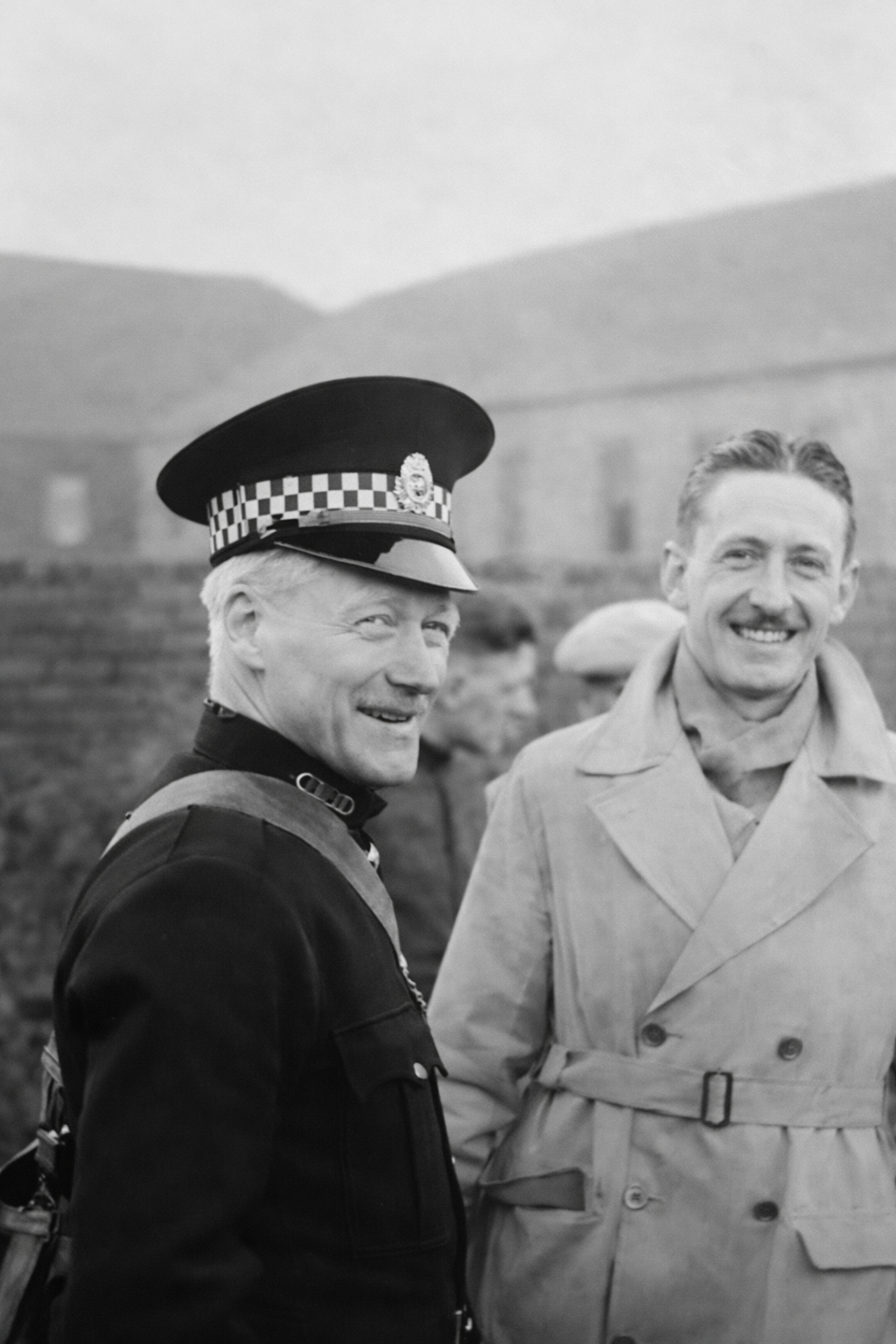
Constable Alexander ‘Sanny’ Lumsden circa 1944
On the evening of Wednesday, 25th September 1946, a deputation comprising members from all ranks of the Airdrie Burgh Police visited Sanny at his home on Howletnest Road.
During this visit, they presented him with a Westminster chiming clock as a token of appreciation for his years of dedicated service.
In the absence of the Chief Constable, Sergeant William White conducted the presentation. He delivered a brief address in which he expressed high praise for Sanny’s exemplary service. Sergeant White highlighted Lumsden’s contributions, including his work on street duty, his role at Messrs Stewarts’ and Lloyds’ Imperial Tube works, and his later responsibilities as a mechanic in the police garage. Additionally, Sergeant White noted that the local fire brigade had also benefited from Lumsden’s extensive mechanical and firefighting expertise.
Sergeant White, on behalf of his colleagues, wished him a long and happy retirement. Inspector William Taylor also spoke warmly about Lumsden’s period of service. He also thanked him for his many years of service to the Ambulance section and the Airdrie Burgh Police Mutual Improvement Association, his involvement in the social activities and the role he played as Master of Ceremonies at the official functions. He added his own best wishes for the future.
After expressing his gratitude for the tributes and the thoughtful gift, Sanny, together with his wife, hosted the deputation, providing an opportunity for his former colleagues to enjoy their company in a spirit of camaraderie and appreciation and of course a few drinks and songs.
Sanny enjoyed his retirement playing bowls, still competing in police competitions. He was an excellent bower, winning many trophies during his service and retirement.
Sanny was diagnosed with cancer in 1960, he fought the condition bravely however, on the 30th of October 1962, whilst a patient at the Western Infirmary, Glasgow, he lost his fight and passed away peacefully with his family by his side.
Sanny exemplified unwavering professionalism and commitment throughout his remarkable policing career, serving his local community with distinction. His years of service encompassed both world wars, a period that demanded extraordinary resilience and devotion from those in public service. Lumsden’s steadfast presence during these turbulent times brought reassurance and safety to the people of Airdrie.
His legacy stands as a testament to the values of duty, integrity, and dedication. Through his determined efforts, he earned the respect and admiration of both colleagues and the wider community, leaving behind an enduring example of what it means to serve our communities.